Multi-hyphenate creatives Arturo Salazar and José Ruiz formed Ediciónes Réplica six years ago, during the 2020 lockdown, through conversations about their shared passion for photography and photobooks, specifically those coming out of Latin America.
The duo met during their time in art school in Colombia. It wasn’t until they reconnected after graduating that they discovered their synergies as researchers and curators. That research now takes the form of books, exhibitions, or both; the two formats are not separate outputs but interconnected ways of extending an inquiry. Crucial to their approach is an experimental, materially driven practice: unusual layouts, bindings, design strategies, and exhibition displays (and museographies) that invite audiences into the research itself.
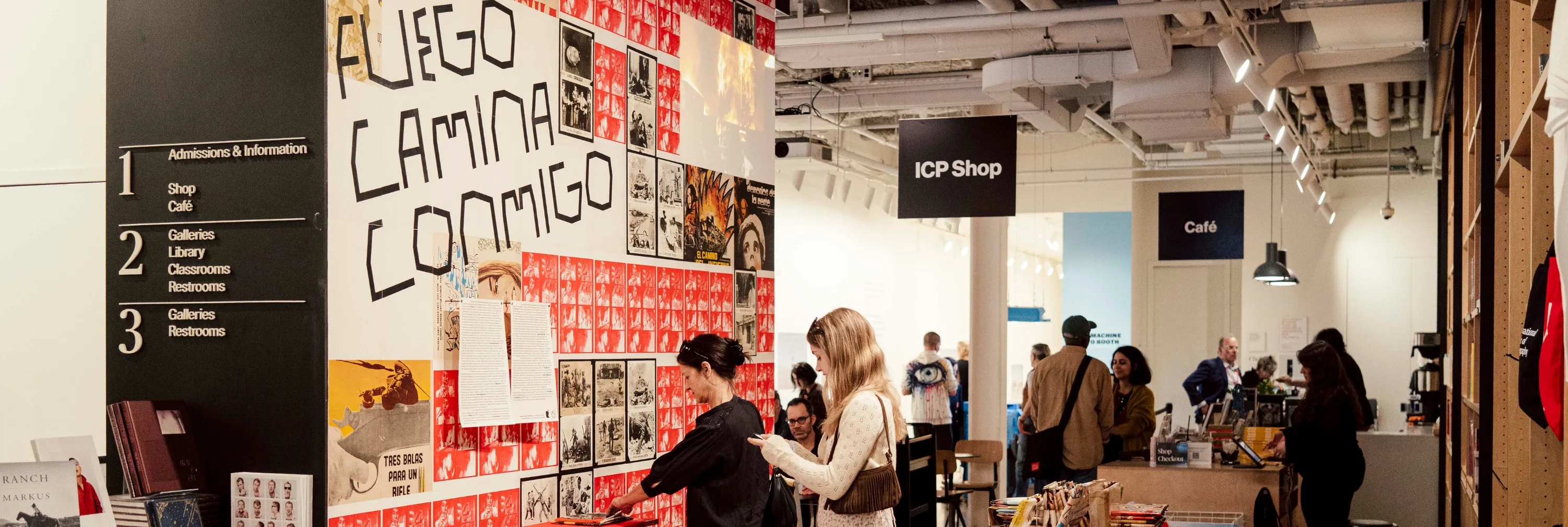
Their latest project, Fuego Camina Conmigo (Fire Walks With Me), a 2025 book–turned–exhibition created in collaboration with Riso studio La Bruja Riso, is now on display in ICP’s Shop. The Book on the Wall exhibition combines video, Riso printed materials, and original movie posters as theatre lobby cards.
What were once posters used by theaters in twentieth century Colombia to invite people to see a film are now recontextualized forty to fifty years later, thus framing a conversation about Latin American photo and film in New York City, and in English.
In addition to taking shape on ICP’s Book on the Wall, their book Fuego Camina Conmigo was also selected for the Rencontres d’Arles Book Awards, under The Author Books shortlist.
ICP: Your project Fuego Camina Conmigo is on display in ICP’s Book on the Wall. Can you describe where it began?
Ediciones Réplica: The project brings together original movie lobby cards and promotional materials, from Colombia, with stills from films that feature fire. We wanted to make a book that could speak about fire through the material itself.
The material for Fuego Camina Conmigo should not exist. The promotional contracts with distributors and theaters required it to be destroyed. Because it was photographic material, the easy way to do that was to set it on fire.
That was the question: why do these materials exist if that was the goal? And how can we speak about fire with something that is not on fire?
ICP: Why was it important to use original materials in the book rather than reproduce them?
ER: For us, it is super important that the reader understands the original material: the weight, the smell, the paper. We could have scanned the material and reprinted it, but we decided to give the reader original material in order to understand how it looks and how it works.
When you leave the book in the heat, it starts a conflict. It talks about the reaction of the material. That is why we always say our books do not have a PDF, because they do not work virtually. They are all conceptualized in the material.
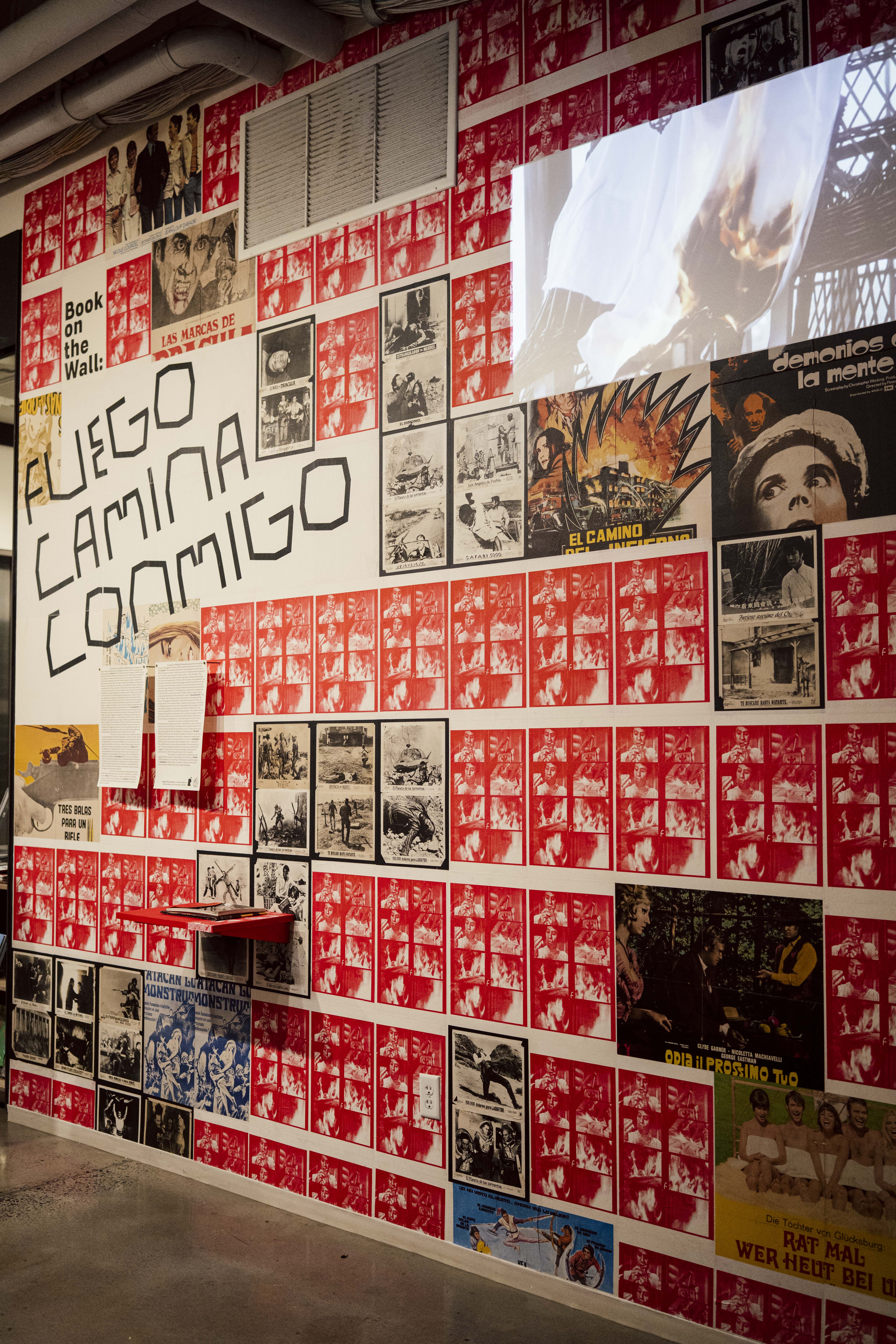
Image credit: Jutharat 'Poupay' Pinyodoonyachet
ICP: Tell me how Fuego Camina Conmigo came to ICP?
ER: We left some original prints out of the copies we made, and we started thinking with our friends at La Bruja Riso, an editorial press in Medellín, about which materials could enter the world in another way.
We were thinking about the lobby cards and movie posters, and how we could reprint the original materials we left behind as a modular system in ICP's space. These posters were originally how theaters in the twentieth century invited people to see a film. In many cases, they were wheatpasted on streets and at theater entrances.
Because Book on the Wall is at the entrance of ICP, the best idea was to paste all the original posters and materials on top of the wall. Not with the intention of framing them or making them cleaner, but rather we preferred to do it with beauty.
ICP: The English translation of the book also takes a unique form. How did that develop?
ER: The book is made from lobby cards, and at the end there is a text in Spanish. We began thinking with Ximena Escobar & Andrew Smith from La Bruja Riso about how to translate it into English. The easy way would have been to rewrite the text in English, reprint it on a sheet, and put it inside the book. But we decided that it was too easy.
Instead, we created a matchbook. The English translation is inside a match case, and when you unfold it, you find a square of original paper that was left behind in the production of the Spanish edition.
It is always about how we can use what is left behind. That is our methodology.
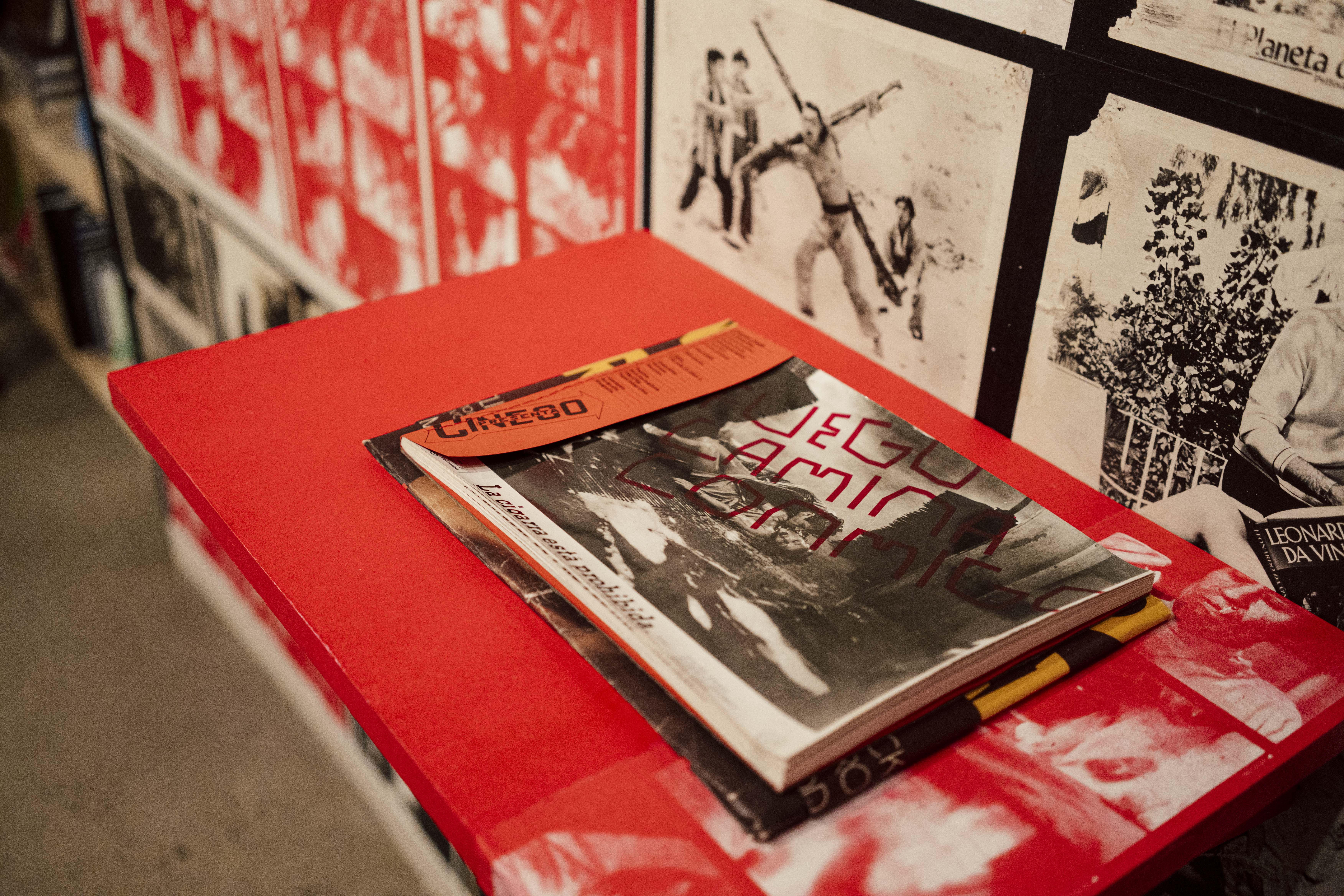
Image credit: Jutharat 'Poupay' Pinyodoonyachet
ICP: The book launch itself became part of the project. What happened?
ER: When we launched the book in Ximena and Andrew’s studio in Medellin, we recreated the scene of how this material should have been burned forty or fifty years ago. We made a fire on the ground and started burning the original sheets and lobby cards that we did not use in the book. At the end of the studio, there was a projection of cinematic stills of fire, which we reprinted in risograph with La Bruja Rizo. That projection is also part of the ICP exhibition.
We like to tell that story because that is the way we like to approach archives. They are not things or materials that should only be used to make books and then never consulted again. We use them to understand that they are alive.
ICP: That’s really powerful. How does it feel to have your work shown in New York for the first time?
ER: I think one of the efforts we made in the last few years is to go to different countries: Mexico, Chile, Argentina, Venezuela, and to situate these conversations with the people there as well as start new conversations. And that's the best part of making books, because every book always starts a new conversation.
And that's our excitement here, to start new conversations in English and let the books take on a new life. Having this material which centers Latin American photographers, in the same frame as global contemporary photography is really important to us.
ICP: Can a book ever be a finished object?
ER: No. We launch the book, but after that it starts its life and helps us conceptualize it further. With Fuego Camina Conmigo, we did not know that when you put many pieces of photographic paper together and heat comes, the paper moves like a flame. That was an amazing surprise. With Libro Ladrillo (our book shaped like a brick) when you use it, pass it around, and store it, it begins to lose ink. It leaves a trace.
We do not like to think of the book as a finished object, but more like the beginning of a life—it has its own journey.