

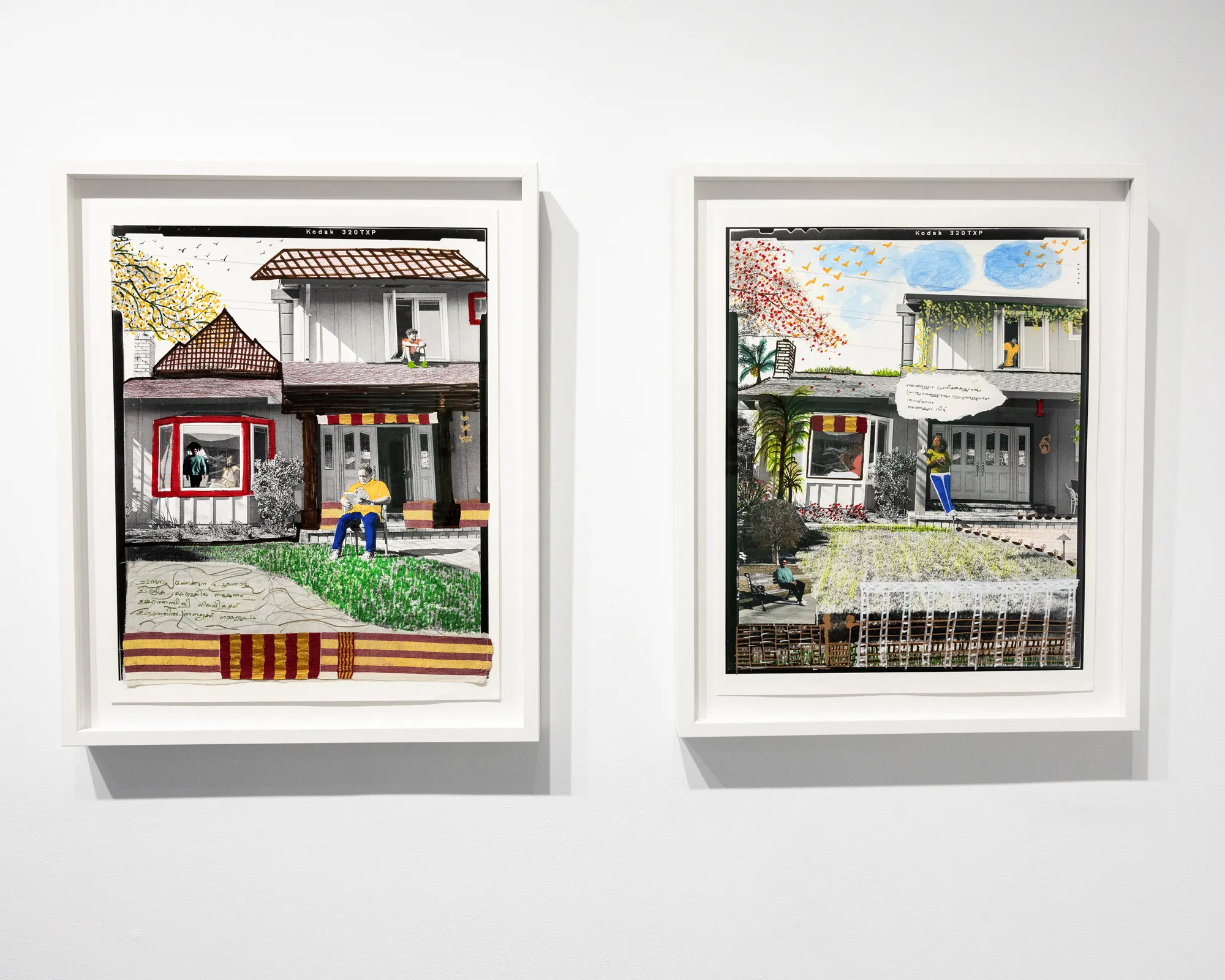
ICP alum Ashima Yadava (Documentary Practice and Visual Journalism '20) opened a solo exhibition Front Yard, on display now at Chung 24 Gallery in San Francisco, until February 14, 2026.
Front Yard uses collaboration as an equity mechanism and offers an in-depth conversation of the perceived realities of various families all over the Bay Area. Yadava brought these groups into the creative process, inviting them to color or embellish black and white prints and thus allowing their unique perspectives into the work.
Yadava said the project attempts to sidestep the problematic one-sided gaze that has come to define documentary photography.
In her artist statement, Yadava said: “One family used thumbprints to make balloons with Tamil text that translates to, ‘Everything one needs to learn is learned within the family with unconditional love for each other.’ In another instance, a family used flowers to illustrate Urdu text that reads ‘Abhi na chhed mohabbat ke geet ai mutrib, abhi hayaat ka mahaul ḳhush-gavaar nahin.’ (Do not sing of me of love, in times of such unpleasantness.)”
Yadava continued: “This project helped me understand the realities of my communities and see how easily we could break barriers of judgment by opening our worlds to each other. While humanity is fighting wars and diseases—with isolation and distrust perhaps the antidote is in the collaborative sowing of seeds that represent, affirm, and bind us all.”
Yadava graduated as a Director’s Fellow from ICP’s Documentary Practice and Visual Journalism program in 2020.
She said: “I had taken a large format class with Justine Kurland while I was a student at ICP. When I began working on the Front Yard series, the slow pace of using a 4×5 large-format camera gave me time to reflect on my role as a photographer. I had seen India represented a certain way through images shaped largely by the Western male gaze, making me very aware of the problematic one-sided perspective that is synonymous with documentary photography. In order to disrupt that dynamic, I invited the families I photographed to intervene—to color or embellish the black and white images freely and determine how they wished to be seen. In Front Yard, collaboration becomes a mechanism of equity, offering a more in-depth conversation about perceived realities.”
Ashima Yadava